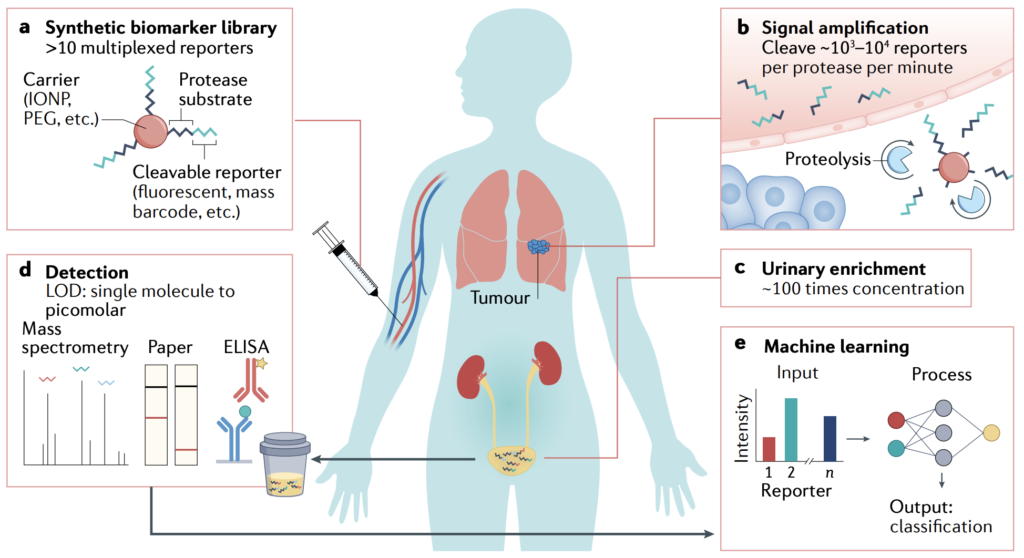
Our review entitled “Synthetic biomarkers: a twenty-first century path to early cancer detection” was published in Nature Reviews Cancer! Congratulations to Gabe and the team! Read the full manuscript here.
Summary | In 2019, the NCI Division of Cancer Prevention co-organized a think tank meeting on synthetic biomarkers for early detection. We wrote this review to summarize the current science and as a clarion call for more scientists and engineers to work together to solve this important problem. We also dedicated the article to the late Dr. Sam Gambhir, a visionary pioneer and thought leader in bioengineering who devoted his career to developing methods for early disease detection.
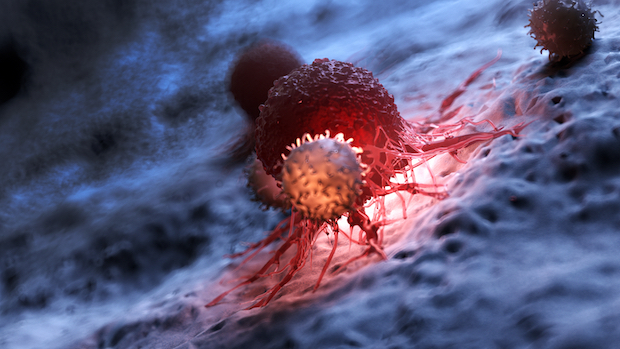
A team of researchers led by bioengineers at the Georgia Institute of Technology is expanding the precision and ability of a revolutionary immunotherapy that is already transforming oncology. CAR T-Cell therapy has been hailed by patients, clinical-researchers, investors, and the media as a viable cure for some cancers.
CAR T-Cell therapy involves engineering a patient’s T-cells, a type of white blood cell, in a lab. Then a chimeric antigen receptor (CAR) is added, and these customized immune cells are returned to the patient’s body, where they seek and destroy cancer cells. That’s how it works, when it works.
It’s a new, evolving, and booming area of immunotherapy, with more than 500 clinical trials analyzing CAR T-cells for cancer treatment going on right now around the world.
“These therapies have proven to be remarkably effective for patients with liquid tumors – so, tumors that are circulating in the blood, such as leukemia,” said Gabe Kwong, associate professor in the Wallace H. Coulter Department of Biomedical Engineering at Georgia Tech and Emory. “Unfortunately, for solid tumors – sarcomas, carcinomas – they don’t work well. There are many different reasons why. One huge problem is that the CAR T-cells are immunosuppressed by the tumor microenvironment.”
Kwong and his collaborators are changing the environment and making some cell modifications of their own to enhance the way CAR T-cells fight cancer. They’ve added a genetic on-off switch to the cells and a developed a remote-control system that sends the modified T-cells on a precision invasion of the tumor microenvironment, where they kill the tumor and prevent a relapse. And they explain it all in a study published recently in the journal Nature Biomedical Engineering.
The latest study builds on the lab’s body of work exploring remotely controlled cell therapies, in which the researchers can precisely target tumors, wherever they are in the body, with a local deposition of heat. “And this heat basically activates the CAR T-cells inside the tumors, overcoming the problems of immunosuppression,” said Kwong.
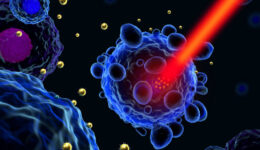
In the earlier study, the researchers did not clinically treat tumors, but they are doing that now with the new work. To generate heat in a mouse’s tumor, they shone laser pulses from outside the animal’s body, onto the spot where a tumor is located. Gold nanorods delivered to the tumor turn the light waves into localized, mild heat, raising the temperature to 40-42 Celsius (104-107.6 F), just enough to activate the T-Cells’ on-switch, but not so hot that it would damage healthy tissue, or the T-cells. Once turned on, the cells go to work, increasing the expression of cancer-fighting proteins.
The real novelty, Kwong said, was in genetically engineering clinical-grade CAR T-Cells, something the team worked on for the past three years. Now, in addition to a switch that responds to heat, the researchers have added a few upgrades to the T-cells, rewiring them to produce molecules to stimulate the immune system.
Localized production of these potent, engineered proteins (cytokines and Bispecific T-cell Engagers) has to be controlled precisely.
“These cancer-fighting proteins are really good at stimulating CAR T-cells, but they are too toxic to be used outside of tumors,” said Kwong. “They are too toxic to be delivered systemically. But with our approach we can localize these proteins safely. We get all the benefits without the drawbacks.”
The latest study shows the system cured cancer in mice, and the team’s approach not only shrunk tumors but prevented relapse – critical for long-term survival. Further studies will delve into additional tailoring of T-cells, as well as how heat will be deposited at the tumor site. A gentle laser was used to heat the tumor site. That won’t be the case when the technology moves on to human studies.
“We’ll use focused ultrasound, which is completely non-invasive and can target any site in the body,” Kwong said. “One of the limitations with laser is that it doesn’t penetrate very far in the body. So, if you have a deep-seated malignant tumor, that would be a problem. We want to eliminate problems.”
The research was funded by the NIH Director’s New Innovator Award (DP2HD091793), the National Center for Advancing Translational Sciences (UL1TR000454), and the Shurl and Kay Curci Foundation.
Our work on engineering CAR T cells to turn on and fight cancer in response to localized heat was published in Nature Biomedical Engineering! Congratulations to Ian, Ali, and the team! Read the full manuscript here.
Summary | Treating solid tumors with chimeric antigen receptor (CAR) T cells typically results in poor responses. In this study, we developed a new class of CAR T cells that are switched on by localized heating to release potent biologics that are otherwise too toxic to use systemically. Thermal targeting of CAR T cells opens the door for spatial control to potentiate cancer therapy.
Our review on biomaterials that interface with synthetic immunity to improve engineered T cell therapies is published in Advanced Healthcare Materials! Congrats to Ida, Quoc, and the team! Read the manuscript here.
Our work on synthetic antigen-presenting cells for antigen-specific activation of T cells was published in Advanced Therapeutics! Congratulations to Shreyas, Anna, and the team! Read the full manuscript here.
In the world of synthetic biology, the development of foundational components like logic gates and genetic clocks has enabled the design of circuits with increasing complexity, including the ability to solve math problems, build autonomous robots, and play interactive games. A team of researchers at the Georgia Institute of Technology is now using what they’ve learned about bio-circuits to lay the groundwork for the future of programmable medicine.
Looking like any other small vial of clear liquid, these programmable drugs would communicate directly with our biological systems, dynamically responding to the information flowing through our bodies to automatically deliver proper doses where and when they are needed. These future medicines might even live inside us throughout our lives, fighting infection, detecting cancer and other diseases, essentially becoming a therapeutic biological extension of ourselves.
We are years away from that, but the insights gained from research in Gabe Kwong’s lab are moving us closer with the development of ‘enzyme computers’ — engineered bio-circuits designed with biological components, with the capacity to expand and augment living functions.
The story of this paper begins two years ago when, Holt said, “our lab has a rich history of developing enzyme-based diagnostics; eventually we started thinking about these systems as computers, which led us to design simple logic gates, such as AND gates and OR gates. This project grew organically and we realized that there were other devices we can build, like comparators and analog-digital convertors. Eventually this led to the idea of taking an analog-to-digital converter and using that to digitize bacterial activity.”
Ultimately, they assembled cell-free bio-circuits that can combine with bacteria-infected blood, “with the basic idea that it would quantify the bacterial infection — the number of bacteria — then calculate and release a selective drug dose, essentially in real time,” said Holt, a Ph.D. student in Kwong’s Laboratory for Synthetic Immunity and lead author of the paper.
The researchers sought to construct bio-circuits that use protease activity to process biological information under a digital or analog framework (proteases are enzymes that break down proteins into smaller polypeptides and amino acids). The team built its analog-to-digital converter with a tiny device, made only of biological materials, that changed signals from bacteria into ones and zeroes. Then, the circuit used these numbers to choose the proper dosage of drugs needed to kill the bacteria without overdosing.
That’s the traditional approach — bio-circuits digitizing molecular signals, allowing operations to be carried out by Boolean logic. The second part of the team’s new paper takes a more nuanced approach, with a focus on analog circuits as opposed to digital. “We treat protease activity as multi-valued, signals between one and zero,” Holt said.
That multi-valued approach led to yet another idea, and ultimately to the bigger picture of analog bio-circuits.
“We got tempted by this idea of fuzzy logic, where you can think about what happens if there’s a signal between zero and one,” he added. “That’s more like an analog circuit. We were really inspired by this concept, so we decided to build analog bio-circuits with the same basic materials as before — proteases and peptides. And we were able to solve a mathematical oracle problem, Learning Parity with Noise.”
The ability to process information from the biomolecular environment with an analog framework is critical, according to Kwong.
“Fuzzy logic is interesting because biology doesn’t think in zeroes and ones,” he said. “Biology operates as a spectrum. So if you think about enzymatic activity, it’s never just on and off. It’s on, and the activity can be anywhere between zero and one. So the long term goal is to recognize that biology is not as simple as a digital electronic circuit. You actually need some capacity to work with analog signals.”
This work was funded by an NIH Director’s New Innovator Award (Award No. DP2HD091793) as well as an R01 from the NCI (GR10003709). Any opinions, findings, and conclusions or recommendations expressed in this material are those of the authors and do not necessarily reflect the views of the NIH.
Competing interests: Gabe Kwong is co-founder of and consultant to Glympse Bio, which is developing products related to the research described in this paper. This study could affect his personal financial status. The terms of this arrangement have been reviewed and approved by Georgia Tech in accordance with its conflict of interest policies. Holt and Kwong are listed as inventors on a patent application pertaining to the results of the paper. The patent applicant is the Georgia Tech Research Corporation. The application 24 number is PCT/US19/051833. The patent is currently pending/published (publication no. WO 25 2020/061257). The biological analog-to-digital converter and the analog protease circuits are covered in the patent.
Our work on engineering biological circuits was published in Nature Communications! Congratulations to Brandon and the team! Read the full manuscript here.
Summary | Biological circuits engineered to interface with living systems will enable new applications for programmable immune therapies and diagnostics. In this study, we explored how treating proteases as ‘biological bits’ could be used to design cell-free biocircuits with the capacity to perform digital operations such as analog-to-digital conversion for drug delivery, as well as analog operations that implement ‘fuzzy logic’ to solve mathematical problems.
Our review on the opportunities, challenges and the current state-of-the-art for remote control of immune cells to increase treatment precision and safety profile is published in Theranostics! Congrats to Lena and Ali! Read the manuscript here.
Our work on heat-triggered remote control of CRISPR-dCas9 for tunable transcriptional modulation was published in ACS Chemical Biology! Congratulations to Lena and the rest of the team! Read the full manuscript here.
Summary | CRISPR-based approaches have achieved wide success in modulating gene activity to control cell function and are potential tools for clinical therapies. However, the lack of precise methods to deliver and control Cas protein expression in vivo remains a critical hurdle. Here we develop a tunable, heat-triggered platform that regulates mammalian cell transcription by remote control of dCas9 transcriptional modulators.
Our work with the Qiu group is now online in PLoS Computational Biology! The activity of enzymatic proteins, which are called proteases, drives numerous important processes in health and disease: including cancer, immunity, and infectious disease.
Many labs have developed useful diagnostics by designing sensors that measure the activity of these proteases. However, if we want to detect multiple proteases at the same time, it becomes impractical to design sensors that only detect one protease. This is due to a phenomenon called protease promiscuity, which means that proteases will activate multiple different sensors.
Computational methods have been created to solve this problem, but the challenge is that these often require large amounts of training data. Further, completely different proteases may be detected by the same subset of sensors.
In this work, we design a computational method to overcome this problem by clustering similar proteases into “subfamilies”, which increases estimation accuracy. Further, our method tests multiple combinations of sensors to maintain accuracy while minimizing the number of sensors used.
Together, we envision that this work will increase the amount of useful information we can extract from biological samples, which may lead to better clinical diagnostics.


 Summary | CRISPR-based approaches have achieved wide success in modulating gene activity to control cell function and are potential tools for clinical therapies. However, the lack of precise methods to deliver and control Cas protein expression in vivo remains a critical hurdle. Here we develop a tunable, heat-triggered platform that regulates mammalian cell transcription by remote control of dCas9 transcriptional modulators.